
How to Set AI Agent Guardrails for On-Topic Support Chats
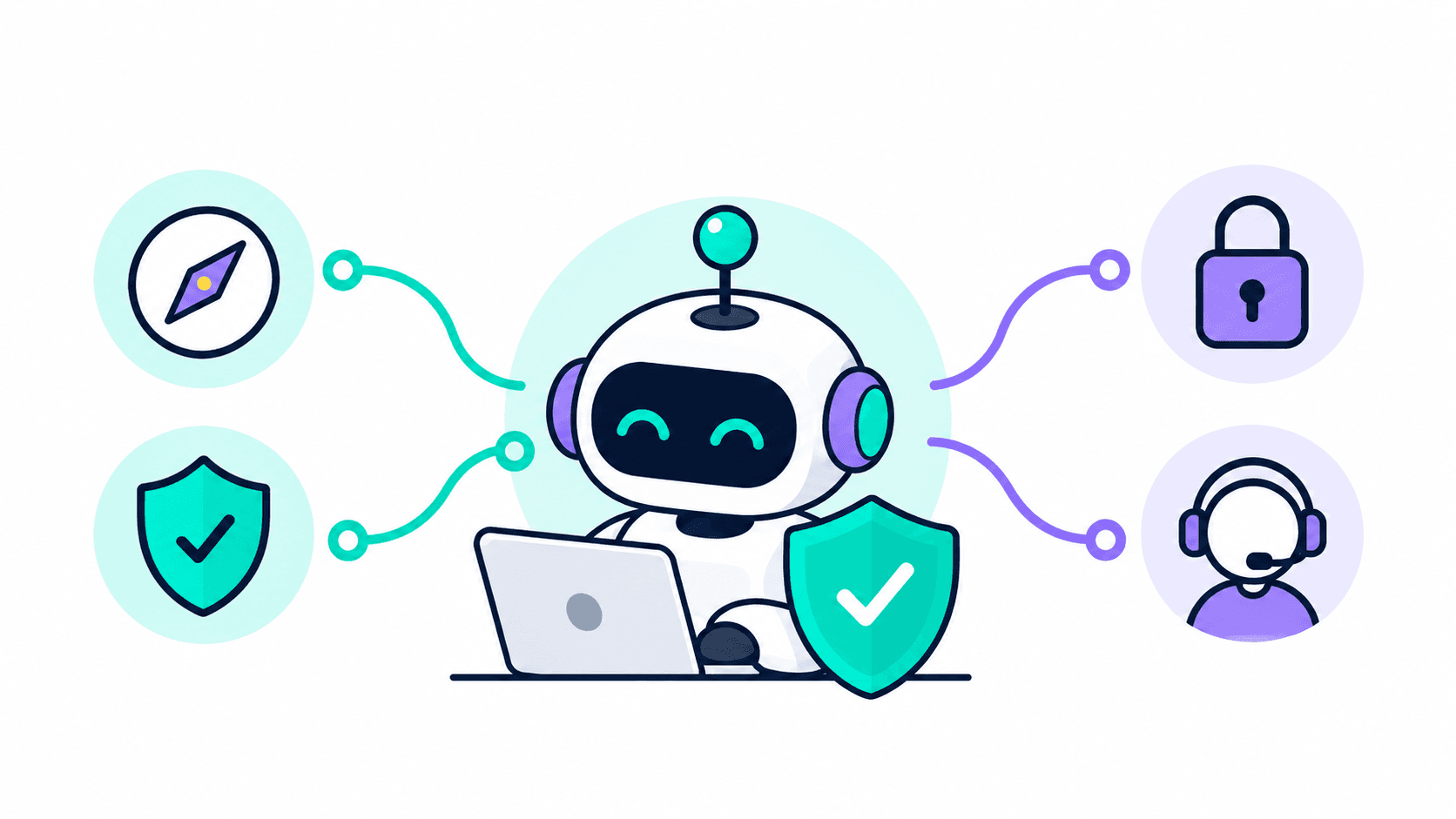
To keep an AI agent on topic, organizations should establish guardrails at multiple levels by clearly defining its scope, screening user requests, relying on approved information, restricting unauthorized actions, reviewing responses, and providing a way to escalate complex issues to human representatives. Simply instructing an AI agent to “stay on topic” is not enough to ensure safe and reliable performance. Implementing appropriate safety measures is essential to reducing potential risks. Whether serving customers in the Philippines, supporting US-based clients, or operating globally, businesses should establish a clear objective: to resolve supported customer inquiries accurately without inventing company policies, exposing confidential customer information, or promising actions the AI agent cannot perform.
Key Takeaways
- Define both what the agent may discuss and what it may do.
- Separate off-topic requests from valid questions that need clarification or human support.
- Combine written instructions with knowledge controls, permissions, and response checks.
- Test realistic conversations, including language changes and attempts to override instructions.
What Are AI Agent Guardrails?
AI agent guardrails are a set of instructions, rules, policies, and technical controls designed to guide an AI agent’s behavior and ensure it operates within defined boundaries. They help determine what the agent is allowed to discuss, what information it can access, which tasks it can perform, and how it should respond to different user requests. Unlike a simple instruction to “stay on topic,” guardrails provide multiple layers of protection to reduce inaccurate answers, inappropriate responses, unauthorized actions, and potential security risks.
A Six-Step Framework on Setting Up AI Agent Guardrails
1. Write a scope policy your team can actually use
Start with a one-page policy describing supported topics, approved information sources, permitted actions, and escalation triggers. Have your support manager approve it before configuring the agent.
For example, a retail assistant might explain return requirements but lack authority to approve exceptions.
Use this starter instruction:
“You help customers with our products, orders, billing, and returns. Use approved business information and verified tool results. Clarify unclear requests. Briefly redirect unrelated questions to supported topics. Acknowledge greetings without extending unrelated conversation. Never invent policies, promise exceptions, or claim an action succeeded without confirmation. Escalate missing information, restricted actions, and requests for a person.”
This directly instructs the model on what to do, what are the bounds of engagements and finally the right way to respond.
2. Route each request using conversation context
Use a relevance check, a rule-based or AI-assisted decision about whether a request belongs within the agent's role. A practical routing policy can be:
| Request type | Recommended response |
|---|---|
| Supported and sufficiently clear | Continue the approved support workflow. |
| Ambiguous | Ask one focused clarifying question. |
| Unrelated | Briefly redirect to supported topics. |
| Supported but outside the agent's authority | Explain the limit and offer human support. |
Evaluate every new message alongside relevant conversation history. For example, a customer replying with "Can you change it?" may refer to the delivery address discussed earlier in the conversation.
3. Require evidence for business-specific answers
Grounding involves generating responses based on verified, approved information rather than unsupported assumptions. Anthropic recommends limiting responses to provided documents, verifying claims against reliable sources, and allowing the model to express uncertainty when information is insufficient. These practices help minimize inaccuracies but cannot eliminate them entirely.
For example, a Philippine shop should not promise delivery to Cebu by Friday without an approved estimate. A business serving US customers should not substitute its Philippine return policy for the applicable US policy. Finally, when evidence is missing or contradictory, configure clarification or escalation, not a plausible guess.
4. Protect instructions and restrict system actions
Prompt injection is an attempt to redirect the agent through instructions embedded in user messages or material it reads. An uploaded document or tool result can contain such instructions, not just the customer's chat message. Treat external content as information to evaluate, never as authority to override the agent's governing instructions.
Separately, enforce permissions in your application. The agent may be allowed to explain a refund policy without being allowed to issue refunds. Require authentication and account-level authorization before accessing private records.
Use read-only access where practical, validate requested actions, and require approval for consequential changes. If a required authorization check fails or times out, stop the action. Do not leave these decisions solely to the model's judgment alone.
5. Check the response before the customer sees it
Configure an output check to ask whether the draft addresses the supported request, stays within policy, and avoids unauthorized disclosures or commitments.
For factual claims, check that the cited document or system result actually supports the answer. A response that sounds relevant can still be wrong. When validation fails, use a controlled fallback: correct the response within a limited number of retries, ask for clarification, or escalate. Do not let the agent retry indefinitely.
Pass along the customer's goal, relevant verified details, attempted steps, and the escalation reason. Include only information the receiving team needs.
For Philippine teams supporting international customers, define the receiving team, operating hours, and time zone. Outside staffed hours, acknowledge the request and explain the actual follow-up process; do not imply a live transfer occurred.
6. Test conversations, then monitor real use
Build a test set using redacted customer support examples that cover normal queries, ambiguous follow-ups, unrelated topics, mixed requests, malicious instructions, and unavailable tools. Test English, Filipino, and code-switching for Philippine deployments, as well as market-specific policies and date, currency, and time-zone ambiguities for international support. Evaluate performance by measuring topic drift (unsupported requests answered substantively) and false refusals (valid requests incorrectly rejected). Also monitor resolution quality, successful handoffs, response times, and operating costs. Repeat testing whenever prompts, models, knowledge sources, or integrations change.
Common Mistakes That Undermine Chatbot Guardrails
- Using a keyword blacklist as the entire strategy. Do not reject "My account was hacked" simply because it contains a security-related word. Evaluate the customer's support intent.
- Treating every unknown answer as off-topic. A warranty question may belong within scope even when the knowledge base is incomplete. Route the knowledge gap appropriately.
- Optimizing only for fewer escalations. Do not reward the agent for keeping a conversation automated when the customer needs someone with decision-making authority.
Professional Recommendation: Match Controls to Business Risk
For a small team with a limited budget, begin with a narrow set of frequent questions, approved answers, and reliable human handoff. Stabilize that workflow before adding account-changing actions. For a growing or international operation, prioritize access controls, market-specific policies, integration testing, and a named owner for ongoing reviews.
When choosing a provider, request a demonstration using your difficult cases, not only a prepared sales scenario. Ask who maintains the policies, what happens during outages, and how implementation, usage, integrations, and ongoing maintenance are priced. Clarify where customer data is stored, who can access it, and how long logs are retained.
SOFI AI Tech Solutions offers AI discovery, custom integrations, AI agent deployment, smart knowledge search, and ongoing AI operations. Its website also identifies AI chat and sales support among its services.
Those capabilities are relevant to a practical assessment: determine whether your current problem is unclear instructions, missing business information, excessive permissions, or a weak escalation process. Choose the smallest effective improvement aligned with your business goals.
Conclusion: Keep AI Support Useful and Accountable
Effective AI agent guardrails should preserve useful conversation while keeping answers and actions within clear business boundaries. Start with scope, evidence, permissions, and escalation, then improve the system using reviewed conversations.
Book a consultation with SOFI AI Tech Solutions to assess your current support setup, identify where conversations drift, and discuss practical guardrails for your organization. Bring sample chats, current policies, and your integration requirements so the discussion can focus on priorities, trade-offs, and next steps that are practical for your team. Book your consultation here.
Frequently Asked Questions
No. A system prompt helps define the agent's role, but it should be combined with request screening, approved information, restricted permissions, response checks, and escalation. OpenAI recommends layered guardrails alongside authentication, authorization, and standard security controls.
Briefly explain its scope and offer a relevant next step. For example: "I'm here to help with orders, billing, and returns. Which of those can I help you with?" Avoid scolding the customer or answering the unrelated request first.
Test complete conversations covering normal requests, ambiguous follow-ups, topic changes, missing information, attempted instruction overrides, and human handoffs. Include the languages and markets you support. Judge both successful assistance and inappropriate refusals, not just whether the chatbot produced an answer.